"I can't," and nine other excuses
What to do when your child makes excuses
Let her tell you what she's feeling. Then don't hand her the escape hatch right away. An excuse usually comes from something that's hard for her. Could be physical, mental or social. Could be she just doesn't feel like practicing. If the excuse wins, every hard thing later in her life gets an excuse too. So the first move is to help her face the difficulty. And usually, she makes it.
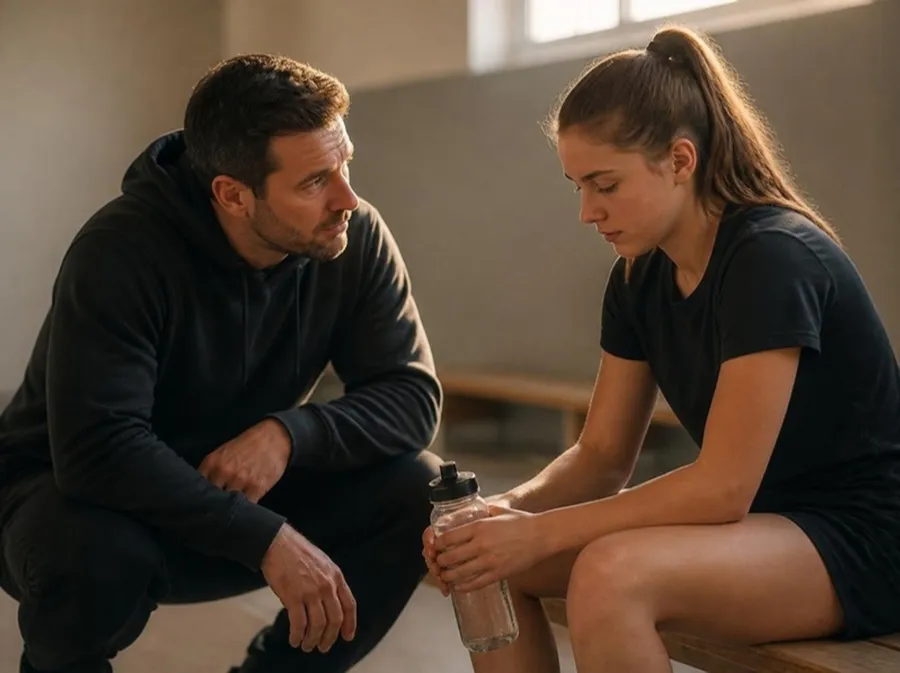
Okay, so. There's a disease I run into all the time at practice. It's called Excusitis. Also known as the Common Excuse.
I hear the excuses my players tell themselves, and the ones they tell me when they show up to practice. And I catch it myself sometimes.
An excuse always sounds best to the person saying it. That doesn't mean I, as the coach, have to accept it. How I answer it is part of the Method. On this site it's called the Next Play Mindset: a simple way to decide what she wants, do the work, and believe she can get there.
1.Let her tell you what she's feeling
I always encourage my players to tell me what they're feeling.
The excuse usually comes from something that's hard for her. Could be physical. Could be mental. Could be social. Could just be not feeling like practicing.
But hearing it doesn't mean I have to accept it.
2.Don't hand her the escape hatch right away
Here's why I don't accept it.
If I let her excuse win, then every difficulty she runs into in her life, she'll use an excuse to avoid trying to get past it.
One of a coach's jobs is to help his players get past difficulties, on the court and off it. So almost always, the first thing I do is get her to face the difficulty. I don't hand her the escape hatch right away.
3.Answer the excuse with one line
These are the 10 most common excuses I hear from the girls on my team.
You'll find all ten in the table below, with what I say back to each one. Notice what almost every answer does. It gets her to at least try to push through the difficulty first.
And usually, she makes it.
4.Ask one question about the excuse
Brian Tracy has a simple test for any excuse.
In his book No Excuses!, he tells how at 21 he was working construction with no diploma, sitting in a small kitchen in the freezing cold, when he realized this would be his life unless he changed something.
His test: has anyone else with the same excuse succeeded anyway? Ask her that about hers.
5.Let her pick her own excuse
This is the homework I give my players.
She picks her own excuse from the list of ten. The one that comes out of her mouth most. Next time she hears herself say it, she answers it with the coach's line. Then she does the drill.
For her: my excuse, my answer
One printable page with all ten excuses and answers, written to her the way I talk to my players. Letter size.
Before you talk to her
Before you answer her excuse, check your own. I catch Excusitis myself sometimes.
What she says, and what you can say back
These are the 10 excuses I hear most from the girls on my team, and what I say back, straight from the book. Almost every answer gets her to try first.
| When she says | You can say |
|---|---|
| "I have no energy." | "Do it with no energy." |
| "I can't." | "You can. I believe in you. Believe in yourself." |
| "I'm not getting it." | "Try again. That's what practice is for." |
| "My head hurts." | "Do what you can." |
| "My stomach hurts." | "I believe you. Do what you can." |
| "My leg hurts." | "Mine too. Do what you can." |
| "My shoulder hurts." | "I believe you. Pass softer." |
| "I'm on my period." | "Try to survive practice." |
| "Practice isn't fun." | "Practice isn't always fun. Try to survive practice." |
| "I don't like this drill." | "You don't have to like every drill. Do it without liking it." |
Two sets of three
John Wooden, the UCLA basketball coach, grew up with two sets of three rules from his father. Don't lie, don't cheat, don't steal. And don't whine, don't complain, don't make excuses.
Questions parents ask
What if she says something hurts?
"I believe you. Do what you can." That's what I say at practice. The stories and methods here are not a substitute for professional medical advice.
Should I push her through every time?
Almost always, the first thing I do is get her to face the difficulty. And usually, she makes it.
Do you ever make excuses?
I catch it myself sometimes. Still, I believe every athlete can beat it. And now you've got the cure in writing.
Is this for boys too?
Yes. The book is for all the girls, at every age. And for the boys too.
Free: The Next Play Mini Journal
By the end of the week she has closed the last game with a clear head, picked one thing to work on at practice, and written her plan for the next one. Seven pages, one a day, five minutes a day, written by Coach Isaac in the same words he uses with his own players.
- Day 1, The Reset. Tonight, before she goes to sleep. Three slow breaths, one honest sentence about what happened, a name for the feeling, and the one thing this game is teaching her. Then she closes the game. Tomorrow is a different page.
- Day 2, The Tape. The next morning. Coaches watch the tape the next day, never the same night, because the same night you only see the mistakes. The next day you see the whole game, including what she did right.
- Day 3, My Why. When the why is strong, the how gets easier. She writes down why she plays, clearly enough to say it out loud.
- Day 4, One Focus. She knows what to fix and why it matters. Now she turns it into one small thing she can do at practice this week, and repeats it. That's how real improvement works.
- Day 5, Winter. A sports season works like the seasons of the year, and game season is winter. You can't cancel winter. What you can do is get better at it: stronger physically, stronger mentally, stronger with your feelings.
- Day 6, Believe. Belief isn't magic. It's what she says to herself, over and over, until it's what she thinks. On this page she writes her own lines instead of the ones other people put in her head.
- Day 7, Next Play. Her game plan for the next game. Eyes forward. The season only moves in one direction.
It's free. Leave your email, and the download opens right away, in Letter and A4.
More from the blog

How to motivate your daughter in sports
She wants more from her sport, from school, from herself. And she ends up on Instagram, TikTok and the group chat instead. How to tell what's stopping her, and what you can say back.
October 1, 2026
How to balance school and sports as a student athlete
School, practice, homework, friends. By the end of the day she's tired, with that feeling of "I didn't get to it." Where that feeling comes from, and the six questions that plan her day.
October 11, 2026
Goal setting for young athletes
She has a list of what she wants. Now what? The six rules for writing each goal, how she picks ten for this year, and why every goal gets three actions and a page of reasons.
October 11, 2026
Based on chapter 11 of From Gazelle to Lioness by Coach Isaac. The excuse test is from Brian Tracy, No Excuses! John Wooden's two sets of three came from his father.